

Why Stocks Drop on Good Earnings News: Spotting Retail FOMO vs Institutional Dark Pool Distribution
Executive SynthesisLearn why stocks frequently sell off after beating earnings estimates how institutional desks use earnings liquidity to distribute shares at Call Wall ceilings and how to spot the trap on Saku.
- Why do stocks often drop right after beating earnings estimates and raising guidance? When a stock rallies strongly into an earnings report and reaches an overbought 14 day RSI near its 30 day Call Wall resistance ceiling institutional funds have already bought ahead of the print. They use the surge in retail FOMO buying volume on earnings morning as exit liquidity while options market makers simultaneously sell shares as implied volatility crushes.
- How can I tell before earnings if a stock is overextended or sitting near mechanical support? You can open any of the 213 free stock dossiers on Saku to inspect the live 12 point technical and valuation matrix including the exact percentage distance to the 30 day Put Wall support floor the 20 day SMA pivot the 30 day Call Wall resistance ceiling and the 14 day RSI regime.
- How does Saku help retail traders avoid buying the top of institutional distribution traps? Saku combines real time off exchange dark pool flow RAG AI synthesis of SEC Form 8 K and Form 4 filings and a free Personal AI Quant Companion at Workstation 4 that monitors your ticker 24/7 and delivers objective shift briefings three times a day.
The Earnings Beat Paradox: Why Record Revenue and Raised Guidance Often Trigger an Immediate Sell Off
Nothing frustrates a self directed investor more than holding a high conviction stock into a quarterly earnings report watching the company beat Wall Street revenue and earnings per share consensus estimates and then watching the stock plunge eight percent the next morning. Whether you have witnessed this classic sell the news reversal in semiconductor titans NVIDIA Corporation NVDA Advanced Micro Devices AMD Broadcom Inc AVGO and Micron Technology MU enterprise software leaders Palantir Technologies PLTR Salesforce CRM Snowflake SNOW and CrowdStrike CRWD or consumer magnets Reddit Inc RDDT Hims and Hers Health HIMS CAVA Group CAVA and Celsius Holdings CELH the underlying mechanism is identical.
Retail traders assume that stock prices react to whether a headline is good or bad relative to published analyst estimates. Institutional hedge funds and pension desks operate on a completely different timeline. By the time a quarterly earnings release crosses the wire at 4:05 PM EST institutional desks have already spent the prior thirty days accumulating shares via off exchange dark pools derived from credit card transaction data supply chain channel checks and satellite telemetry. When the stock rallies fifteen percent into the print and reaches an overbought 14 day Relative Strength Index above 70 the good news is already fully priced in.
During the eighteen years I spent inside enterprise banking at TD Bank Group architecting financial markets technology while holding FINRA and IIROC regulatory licenses I watched institutional execution desks use the massive surge in retail buying volume on earnings morning as an exit liquidity event. Because a fund holding five million shares cannot sell during a quiet Tuesday afternoon without crashing the price against itself it waits for retail FOMO on a glowing earnings headline to absorb its sell orders. We built Saku Financial Inc. and our 213 live stock and crypto dossiers so self directed traders can spot institutional distribution before buying the top of an earnings trap.
See Live Dark Pool Flow & AI SEC Synthesis in Action
Don't just read about institutional order flow—track it live on your favorite stock or crypto ticker right now.
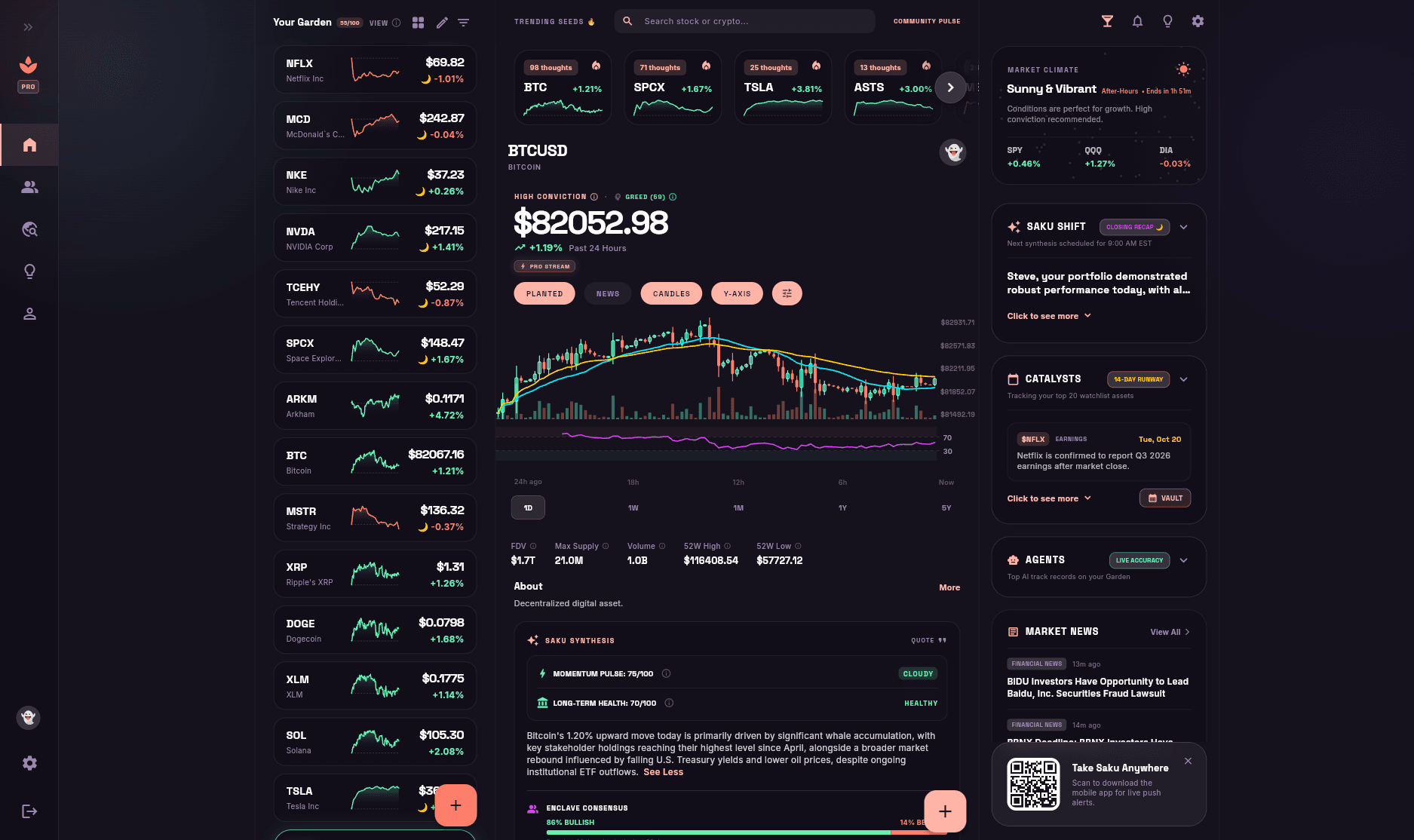
How Options Implied Volatility Crush and Call Wall Pinning Mechanically Cap Post Earnings Rallies
Beyond institutional share distribution the options market plays a massive mechanical role in why stocks stall or reverse after beating earnings. In the two weeks leading up to a major catalyst tracked on our 14 Day Enclave Catalyst Calendar retail traders aggressively buy short dated out of the money call options in high beta names like Tesla Inc TSLA NVIDIA NVDA Coinbase Global COIN Strategy MSTR SoFi Technologies SOFI Robinhood Markets HOOD Applied Optoelectronics AAOI and SanDisk Corporation SNDK. To hedge their short call exposure options market makers buy the underlying stock prior to the announcement pushing price up toward the thirty day Call Wall resistance ceiling.
The second the earnings numbers are released the uncertainty evaporates and implied volatility collapses in an event known as IV crush. As we detailed in our foundational microstructure guide on what a put wall and call wall are in options trading and our execution playbook on 0DTE and weekly put wall vs call wall gamma pinning that rapid drop in implied volatility reduces the delta of out of the money call options.
Consequently market makers no longer need to hold as many underlying shares to stay delta neutral. At 9:30 AM the morning after earnings dealers mechanically dump millions of hedged shares right onto the open market just as retail traders are placing market buy orders. When you inspect the live Saku dossier for any of our 213 tracked tickers before an earnings print you can see the exact thirty day Call Wall resistance ceiling and 14 day RSI regime so you never buy blindly into a dealer de hedging wave.
| Market Intelligence Layer | Legacy Retail Apps | Saku AI Terminal (Free) |
|---|---|---|
| Support & Resistance Zones | Subjective retail trendlines | Mechanical Call/Put Walls, SMA/EMA & 1–100 Momentum Pulse |
| SEC Filings & Breaking News | Delayed headlines & raw 80-page PDFs | Instant event-driven RAG AI synthesis of Form 4, 8-K & 10-Q |
| 24/7 Market Surveillance | Manual price alerts only | 3 House Quants + Personal AI Companion at Workstation #4 |
| Prediction Accountability | Unverified social posts (deleted losses) | 5-Minute Write-Locked Oracle Ledger & Precision Grading |
Saku Agent Use Case Hypothesis One: Auditing Pre Earnings Run Ups and 14D RSI Regimes in Enterprise Cloud and Cybersecurity
How can a self directed trader tell in advance whether an upcoming earnings beat is likely to rally or get sold? The first step is auditing the thirty day pre earnings price velocity and 14 day Relative Strength Index regime across sector peers. Consider enterprise software cybersecurity and data infrastructure leaders Palo Alto Networks PANW Zscaler ZS Cloudflare NET Datadog DDOG MongoDB MDB ServiceNow NOW Oracle ORCL IBM Corporation IBM Samsara IOT Elastic ESTC and Axon Enterprise AXON.
When one of these software leaders enters its earnings window already sitting right at its thirty day resistance ceiling with an overbought 14 day RSI above 68 and a rich trailing P/E multiple institutional desks demand perfection. Even a slight deceleration in next quarter billings guidance inside the SEC Form 8 K press release triggers algorithmic selling back toward the twenty day simple moving average pivot and thirty day Put Wall support floor.
Conversely when a fundamentally healthy company with a strong Saku Fundamental Health score pulls back into its thirty day mechanical support floor prior to earnings with an oversold or neutral 14 day RSI between 32 and 45 expectations are washed out. In that regime even a modest earnings beat forces short sellers to cover igniting a high conviction multi week breakout.
Track live dark pool flow & hatch your Personal AI Quant at Desk #4.
Saku Agent Use Case Hypothesis Two: Reversing the Equation When Bad News Gets Bought at Put Wall Support Floors
The exact mirror image of the good news sell off is the bad news bottom. Have you ever watched a company report a messy quarter lower its full year outlook or face a regulatory headline only for the stock to gap down at 9:30 AM and finish the day up five percent in the green? Look at how institutional value desks accumulate blue chip retail consumer and industrial franchises like Costco Wholesale COST Walmart WMT Home Depot HD Lowe Companies LOW McDonald Corp MCD Starbucks SBUX NIKE NKE Lululemon LULU Uber Technologies UBER Airbnb ABNB DoorDash DASH and DraftKings DKNG.
When a stock has already declined for four consecutive weeks into a widely anticipated negative catalyst institutional funds have already finished selling. As retail traders panic and sell at the 9:30 AM open right at the thirty day Put Wall support floor market makers buy back their short hedges and institutional dark pools absorb the discounted liquidity.
As we demonstrated in our 2026 masterclass on which solutions combine dark pools with AI document analysis and AI diligence and our behavioral guide on buying low and fading irrational exuberance Saku combines live dark pool whale flow with automated RAG synthesis of SEC filings so you can see when smart money is quietly buying a fearful dip across healthcare and biotech leaders Eli Lilly LLY Novo Nordisk NVO Viking Therapeutics VKTX UnitedHealth UNH Intuitive Surgical ISRG Amgen AMGN and Regeneron REGN.
Saku Agent Use Case Hypothesis Three: Separating Retail Hype From Institutional Accumulation in High Beta Frontier Tickers
The tug of war between retail FOMO and institutional distribution is most intense in high beta aerospace AI neocloud and quantum computing equities including the SpaceX Ecosystem SPCX Rocket Lab USA RKLB AST SpaceMobile ASTS Intuitive Machines LUNR IREN Iris Energy IREN Nebius Group NBIS Applied Digital APLD Core Scientific CORZ IonQ IONQ BigBear.ai BBAI SoundHound AI SOUN Oklo OKLO and NuScale Power SMR.
Whenever a viral social media thread pushes one of these names twenty percent above its ten day exponential moving average and twenty day simple moving average right into its thirty day resistance ceiling disciplined Saku traders check the live twelve point technical matrix and SEC Form 4 insider wire before chasing. Waiting for price to retest mechanical support preserves capital and compounds long term returns.
Claim Workstation 4 to Let a 24/7 AI Quant Companion Audit Earnings Risk and Support Levels for You
You never have to guess whether an upcoming earnings catalyst or breaking news headline is a breakout or an institutional bull trap. Inside the Saku Living Agent Sanctuary our three autonomous House Quant Agents publish verified one month price predictions every weekday: Crypto Momentum at 10:00 AM EST Macro and Catalysts at 12:00 PM EST and Fundamental Value at 2:00 PM EST.
Right beside them every Saku user can claim Workstation Number Four completely free to hatch a custom Personal AI Quant Companion. As we covered in our guide on the best AI agents to monitor the stock market 24/7 your companion guards NVDA TSLA PLTR RDDT HIMS AAOI SNDK GOOG or any of our 213 tracked tickers nonstop delivering automated Morning Midday and Closing shift briefings at 9:00 AM 12:00 PM and 4:30 PM EST.
Every prediction staked on Saku locks five minutes after posting onto our immutable Oracle Ledger so every human and AI call is permanently verified. Launch the 100 percent free ad free Saku terminal on Web iOS or Android today to inspect live Put Wall support floors Call Wall ceilings and dark pool order flow across your entire watchlist.
Why do stocks often drop right after beating earnings estimates and raising guidance?
When a stock rallies strongly into an earnings report and reaches an overbought 14 day RSI near its 30 day Call Wall resistance ceiling institutional funds have already bought ahead of the print. They use the surge in retail FOMO buying volume on earnings morning as exit liquidity while options market makers simultaneously sell shares as implied volatility crushes.
How can I tell before earnings if a stock is overextended or sitting near mechanical support?
You can open any of the 213 free stock dossiers on Saku to inspect the live 12 point technical and valuation matrix including the exact percentage distance to the 30 day Put Wall support floor the 20 day SMA pivot the 30 day Call Wall resistance ceiling and the 14 day RSI regime.
How does Saku help retail traders avoid buying the top of institutional distribution traps?
Saku combines real time off exchange dark pool flow RAG AI synthesis of SEC Form 8 K and Form 4 filings and a free Personal AI Quant Companion at Workstation 4 that monitors your ticker 24/7 and delivers objective shift briefings three times a day.
Related Institutional Research
View All Research →StockTwits Alternatives: How to Find Verified Trading Alpha and Spot Fake Gurus
The financial social media landscape is flooded with 'fake gurus' who delete losing trades to artificially inflate their win rates. The best alternative to platforms like StockTwits are networks that use immutable prediction ledgers and mathematically verified accuracy ratings to hold influencers accountable.
Ditch the Spreadsheet: How to Build a Better Stock Watchlist
After spending 18 years at a Big 5 bank I realized retail watchlist apps were completely broken. Stop managing your portfolio in Excel and start using a platform that actually explains why your assets are moving.
Building the First Social Agentic AI for Market Predictions
We did not want another dumb bot that just spits out generic chart advice. We built a living breathing entity that lives on our local server calculates quantitative math in seconds and stakes its own reputation on the ledger alongside you.
Watchlist Versus Portfolio The Psychology of the On Deck Circle
Many beginners confuse their watchlist with their portfolio. Discover how treating your watchlist as a risk free observation zone and using long term health scores can help you profit by simply waiting on the sidelines.
Zero Ad Terminals and Purposeful Gamification Building Sustainable Alpha
Discover how combining a zero ad terminal aesthetic with discipline driven gamification eliminates cognitive fatigue and rewards long term financial competency.
Why 24/7 Trading and Overnight Global Liquidity Are Reshaping the Stock Market for Self Directed Investors
Discover why most institutional price discovery now happens outside standard 9:30 AM to 4:00 PM EST market hours and how 24/7 AI quant agents monitor overnight gaps across stocks ETFs and crypto.

Steven White, MBA
Formerly FINRA & IIROC LicensedFounder & Architect, Saku Financial Inc. • 18-Year TD Bank Group Veteran
Steven spent 18 years at TD Bank Group architecting enterprise product operations, strategy, and financial market technology, and previously held both FINRA and IIROC regulatory licenses. He built Saku to level the playing field—giving self-directed retail investors the same institutional-grade RAG AI synthesis, dark pool order flow, autonomous quant agents, and verified prediction ledgers used by the smart money.
Put Institutional Intelligence to Work.
Track live dark pool prints, read instant RAG AI SEC filing syntheses, and hatch your own personal AI quant companion inside the Saku Sanctuary.